
LESSON 6: Show Openers, Closers & Fillers
7 WAYS TO OPEN AN ILLUSION SHOW
I’m always excited at the start of any live show, even more so with a magic or illusion show.
I wait in anticipation to be wowed or enthralled from the time the lights darken, a voice-over announcement is made or the curtains start to rise.
Suffice to say, the opening of a show is very important in creating the best impression for your show. A good opening gives you a lot of mileage and if you win the audience over from the start, chances are you will have great success with your show.
Of course, a lot depends on your performing environment and venue. You will not be able to create the same kind of feel in a brightly-lit open stage in a mall as you would in a state-of-the-art theatre.
It is important to design your show opening with specific objectives in mind based on your performing environment.
For example, when I perform in corporate or special event settings, my opening is designed to capture the audience’s attention from the start and pull them away from the “distractions” of dinner conversation and the food. However, in a theatre show setting where the audience is already captive, I want to create intrigue, anticipation and an aura of wonder. My objectives are different for both performing environments due to the nature of the show and the technical capabilities of the specific venues.
If you perform in a mall, your opening may be designed to stop traffic so that shoppers stop to watch your show.
Based on different objectives of a show opening, here are a number of ways to start an illusion show.
Appearance of the Illusionist
This is one of the most popular ways to start an illusion show. After all, it makes sense (and is almost expected by the audience) for the illusionist to appear in a puff of smoke at the start of the show.
Some popular illusions for an illusionist to appear include the Flash Appearance, Smoke Chamber, Flambé, Elevator, Shadow Box and the Fire Dome.
https://www.youtube.com/watch?v=nx2MWnkKT-4
Sam Power’s Smoke Chamber
I designed a self-contained solo appearance illusion that I use to start my illusion show. The “Shadow Appearance” coupled with theatrical lighting design and opening video makes for a strong dramatic opening that sets the mood, creates anticipation and grabs the audience’s attention. You can watch it below:
Copperfield’s presentation of Jim Steinmeyer’s “Elevator” illusion for his Flying TV special is arguably one of the greatest appearances to start an illusion show.
This is an interesting “Flambe-style cum Shadow Box” appearance from Ken Strong (although the prop is a bit too shakey for my liking and I do not like having the stage hand directly behind the prop). Nevertheless, it is effective.
https://www.youtube.com/watch?v=r2EVi4oMkgY
An appearance need not be dramatic, Scott Muriel’s “Stack of Boxes” appearance features a comedic appearance that sets the tone for the style of his act. You can watch it below:
I have seen an argument that considers a magical appearance of the illusionist not ideal as the first illusion of the show unless he/ she is already known to the audience.
It is suggested that the appearance is more effective when the audience already knows the performer or has a connection with him/ her. So, an appearance is better to start the second half of a show after an intermission, dance number or variety act.
Some food for thought.
Appearance of an Assistant
This is likely the second most common way to start an illusion show. The illusionist enters the stage, greets the audience (usually non-verbally) and proceeds to make a pretty girl or girls appear.
It achieves the purpose of establishing the presence of the illusionist and presenting a strong illusion effect at the outset of the show.
The Crystal Casket, Fire Cage, Blammo Box and Instant Babe are popular illusions as an opening illusion to produce an assistant.
Michael Giles was one of the very first to perform “Instant Babe”
Presenting an Illusion
I use this approach when performing conditions do not allow me to make myself or an assistant appear. This could be due to a small stage or the lack of side wings to load a person into an illusion.
Almost any illusion will work as it really depends on your personal style and preference. A “girl in box” type illusion or Metamorphosis style would work well.
Some illusions work better than others. For example, I don’t think an illusion where you enter the stage and then make yourself vanish ten seconds later is ideal.
Also, in my opinion, illusions that get to the effect or “action” faster are favoured over longer drawn out sustained effects such as levitations and escapes.
I currently typically perform a one-person vertical sawing if I do an opening illusion but also use a light tubes through girl effect as well as Spiker-style illusion from time to time.
Manipulation or General Magic Act
Many illusionists who first started out with a stage act, may it be a manipulation, general magic or dove act, like to start the show with the act that launched their careers or that they are most well known for. This is especially true if it is an award-winning act.
Most also start the show out of necessity because of the loads or pre-sets required for the act.
Lance Burton opened with his FISM-winning dove act for years. It was only years later in Monte Carlo when he would magically appear at the top of the show, which then led to the dove act.
For new illusionists, from a practical standpoint, an opening stage act that is high impact but is not an illusion is a great benefit as it “saves” from using up an illusion at the start of the show. If you have only two or three illusions, you can still create the visual scale needed for an illusion show.
Walk Out Entrance
When performance conditions do not allow or if you just do not have the budget to present a strong opening illusion, perhaps the most effective entrance you can do is simply walk out onto stage.
The key to a successful walk out is to have confidence in yourself and walk. Choose good music that best personifies your brand and style. If theatrical lighting is available, have the lighting designer design a short but visually appealing sequence to accompany your walk-out.
Don’t rush when you walk onto stage and take your time before you speak or perform. Allow the audience to register your presence. Rushing makes you look nervous or unpolished.
I suggest watching WWE pro-wrestling ring entrances for inspiration. Many entrances are over the top but will give you an idea of the power of a walk-out entrance to create anticipation, excitement and showcase a character’s persona.
Max Maven does a powerful walk-out entrance where he takes his time to allow the audience to “soak in” his presence and “Ming the Merciless-style” image. Then he says “Boo” in a serious deadpan tone. It breaks the tension he builds up with the walk out and gets a great reaction.
Open Stage “Appearance”
This is an interesting and effective “appearance” if the venue allows you to do a complete blackout of the lights.
The show starts with lights panning across an obviously empty stage. Then the stage goes to a complete blackout. Seconds later, a single spotlight turns on from the top center of the stage and the performer is seen on stage, making a surprise “appearance”.
You will need stage marking with luminous glow tape so that you can spot your position in the dark.
Mentalist Marc Salem has used this type of entrance effectively in his shows.
Unusual Appearance
If you are creative performer and have an off-beat stage personality and style, an unusual appearance might work.
Such an illusion/ effect is not a standard appearance per say, it is a surprising introduction of the illusionist with either a magical or special effect.
One of the best examples I can think of is Ed Alonzo’s “Creature Crate” Appearance. A scary-looking small creature carrying a crate enters the stage. It reaches the centerstage and struggles with the weight of the crate on its back and the crate collapses onto the creature, only to reveal Ed popping out of the crate at the same time.
I personally use the first four ways to open my illusion show depending on the scale of the show and performing environment.
Do you have any other effective ways to start an illusion show?
CLOSERS
Like your opener, a show closer should be chosen for intended purposes. Here are two reasons for choosing specific illusions/ acts:
- You want to end the show with a bang
- You want to end the show with the audience experiencing a desired emotion
The first reason is the most common in magic.
“Do your most powerful routine or illusion that really blows them away.” That is fine by my book, no complaints at all. Just be aware that there are other approaches:
- A quiet affair such as a ‘Sympathetic Silks’ or ‘Gypsy Thread’ routine under a single spotlight can do wonders as a closer. Lance Burton ended his first TV special with his ‘Center Tear Newspaper Restoration/ Dove Production’ after an entire hour of stunning manipulations and illusions.
- A dramatic story type effect can be fantastic. Kevin James’ ‘Snowing’ is an excellent example (although overly-performed in my opinion). A heartening and sincere story coupled with the right music makes the effect very strong and ideal as a ‘feel-good’ closer.
- Performing two contrasting illusions back to back as a closer can be very strong especially if choreographed tightly so that the audience does not have a chance to ‘catch their breath’ between illusions
FILLERS
As highlighted in Lesson 5, your illusion show does not consist entirely of just illusions. You will perform supporting material that consists of several stage or stand-up routines as “fillers” to round out the show.
These fillers are very important and great thought must be put into choosing the right routines and acts to complement your show. The fillers should be different in nature from each other and serve a purpose in the show.
Here are different types of supporting material you can perform:
Personality Pieces
These are routines that showcase your personality and get the audience to know & like you. They allow you to establish your performing character, establish the tone of your show and allow the audience to remember you the performer, beyond just your magic & illusions.
More often than not, these routines are talking acts although it is possible to perform a silent routine (to music) to achieve the same purpose. There are no fixed acts that work better than others and personality pieces work based on the unique qualities and personalities of individual performers.
However, just to give you an idea, here are a few popular routines that work as personality pieces.
- Vanishing Bottle
- Multiplying Bottles
- Silk to Egg
- 3 Card Monte & Variations
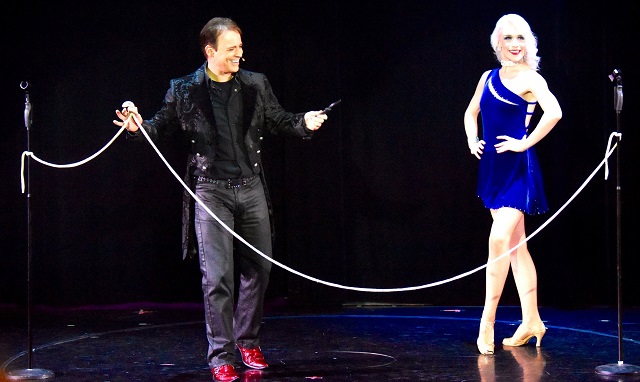
- Cut & Restored Rope/ Professor’s Nightmare
- Torn & Restored Newspaper
Virtually, every performing illusionist features one or several personality pieces in their shows.

Audience Participation or Interaction Routines
These routines are a staple in most illusion or magic shows and involve an audience member(s) as a participant on stage or involve you interacting with multiple audience members.
These routines are generally light-hearted with situational comedy presented for maximum entertainment. They also serve to further your personality and likability to the audience.
Some examples include:
- Head or Arm Chopper
- Do as I Do Routines
- Prediction Routines
- Invisible Deck
- Bill/ Card in Lemon
- Card Stab/ Sword
- Ring/ Watch in Impossible Location
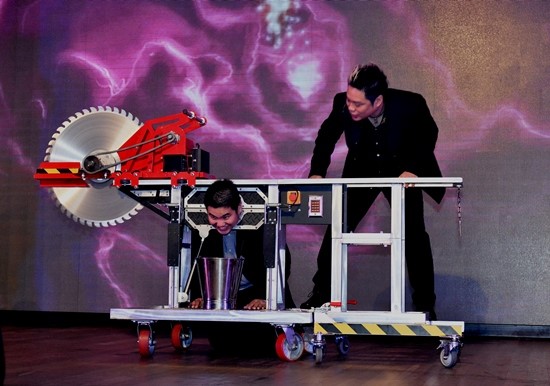
An example from my show would be the “Buzz Saw” performed with a spectator.
High-Impact Visual Acts
Most illusionists did not start off with a large illusion show but first started out performing a high-impact visual act. These acts usually are manipulative, general magic or competition-style acts.
The great thing about such acts is that there are multiple effects in a single act; so, there are many moments of magic in a short period of time. This contrasts with an illusion performance which generally features one or two main effects in the course of the act.

Soft Acts
In contrast to high impact acts, soft acts are just the opposite in tempo, feel and function. Soft acts are generally routines performed to music that act as a nice interlude between larger illusions or acts. They tend to be visual bubble gum for the audience and gives them a chance to mentally “rest” and just sit back, relax and enjoy the magic.
Manipulative acts, story-based routines and visual magic performed under a single focused spotlight to “soft emotional” music best exemplify this type of act.
Some examples include:
- Any manipulative act with cards, coins, billiard balls or any objects you can manipulate
- Floating ball or table
- An elegant rope routine like Tabary’s
- Kevin James’ “Snow Animator” or “Snowstorm in China”
- Linking Rings
Many illusionists use at least one soft act in their show to create theatrical variety and texture.


Close-up Magic Projected on Video Screens
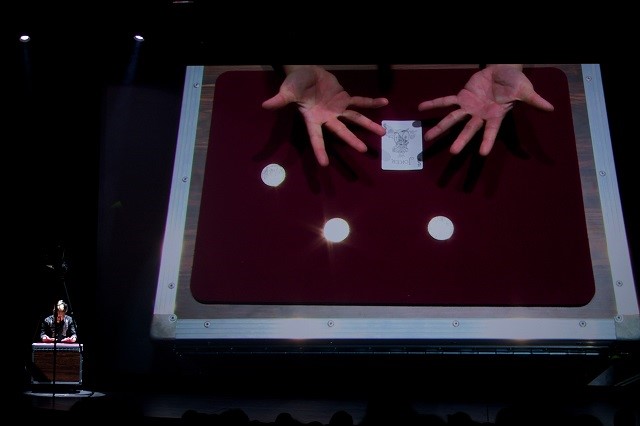
A very popular choice of supporting material is to perform close-up magic for a camera with a live video feed that is projected on a video screen(s).
Most illusionists, like most magicians, started with close-up magic so this is the only chance for illusionists to perform such routines professionally.
Close-up routines provide good variety and contrast to large-scale illusions performed on stage. Psychologically, these routines are also very strong for the audience as they get to watch the magic very clearly as compared to from a distance for stage acts & illusions.
Depending on the routine, the camera used to capture the performance is typically either set in front of the performer or at a top-down angle onto a close-up mat or table.

Illusionettes or Mini Illusions
An illusionist can also feature illusionettes as filler material between full-sized illusions.
Illusionettes are small illusions or large-scale effects that are usually self-contained and can be performed in front of a main theatre curtain while the stage is being reset for full-sized illusion acts.
The term illusionette is likely to have come from Percy Abbott and Abbott Magic Co. has a category of products devoted to illusionettes.
U. F. Grant was also prolific inventor of small illusions.
The great thing about an illusionette is that it is still considered large-scale and maintains the illusion-scale of your illusion show.
Here is a non-exhaustive list of well-known illusionettes on the market:
- Arm or Head Chopper (U. F. Grant)
- Blooming Rose Bush/ Orange Tree (Robert Houdin)
- Bow Sawing (Robert Harbin)
- Dagger Head Chest (U. F. Grant)
- Dancing Hank (N. Hofzinser, Blackstone Sr, Ralph Adams, Don Wayne, Sean Bogunia)
- Dis-Armed (U. F. Grant)
- Electric Sawing (U. F. Grant)
- Floating Table (Losander)
- Gypsy Rope Tie
- Head Twister (Ed Alonzo)
- Large Production Boxes
- Passing Water (Kovari) – Water Through Spectator’s Body
- Pillory Escape (Houdini)
- Ribbon/ Rope/ Chain Through Body or Neck (U. F. Grant)
- Candle/ Torch Through Arm (U. F. Grant)
- Tri-section (Larry White)
- Sword Through Neck (Harry Roydon)
- World’s Fastest Illusion – Vanishing Flower Pot (Al Delage)
- Vanishing Birdcage (De Kolta)
- Vanishing Radio (Robert Harbin)
- Visible Sawing (U. F. Grant)
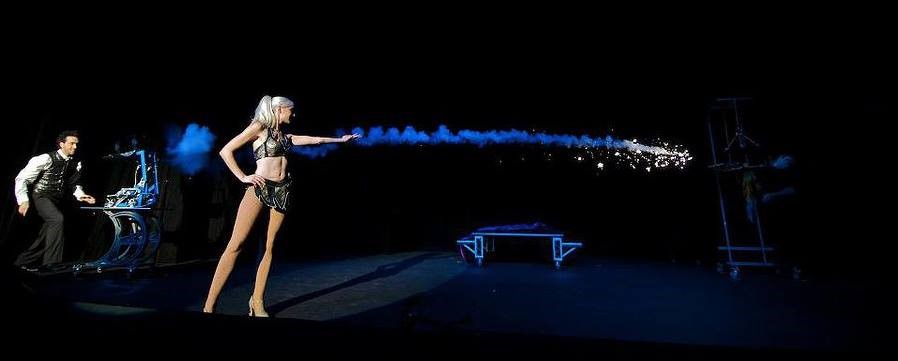
Here is a non-exhaustive list of popular effects and routines that will work well as filler material:
- Sands
- Linking Rings
- Egg Bag
- Giant B’Wave
- Cardio graphic
- Bill in Lemon
- Multiplying Billiard Balls
- Card Manipulation Routine
- Miser’s Dream
- Rope Routine
- Newspaper Tear
- Razor Blades or Needle Swallowing
- Silk to Egg
- Jumbo Invisible Deck
- Straight Jacket Escape
- In & Out Rope
- Thumb Tie
- Ring/ Watch in Nested Boxes
- Linking Himber Rings
- Smash & Stab
- Jumbo Sidekick
- Bank Night Routine
- Confabulation Routine
- Book Test
- Drawing Duplication
- Chair Test
- Blindfold Act
- Copentro
- Hospitality
- Vanishing Bottle
- Zombie Ball
Other Supporting Material
Instead of just magic routines, you can also be creative in having other types of supporting material. These can include:
- Juggling
- Manipulation (the juggling kind, not the magic kind)
- Shadowgraphy
- Circus Acts
- Mime
- Stunts
- Singing
- Storytelling
- Stand-up Comedy
- Playing a Music Instrumental.
- Video Transitions
DOWNLOADS
As a bonus with this lesson, here is an original audience participation “filler” routine that you can use in your show.
This routine was first described in my Mar 1998 “One Man Parade” published in the IBM Linking Ring magazine for which I won two Linking Ring awards. Subsequently, it reappeared in my 2012 illusion/ mentalism book, “Illusionism”.
WEDLOCK – A Light-hearted Comedy Interactive Mentalism Routine

