
LESSON 11: Lighting & Videos
BASIC LIGHTING FOR ILLUSION SHOWS
To enhance your show and bring it to the next level, you need to think about the use of theatrical lighting.
Videos can also be used effectively to enhance a show. This can be in the form of a/ an:
Intro Video – A short video to introduce the show/ performer and set the tone for the show.
“Intermission” Video – To allow for a change of sets, set up an illusion or for a needed break for the performer)
Hype Video – To build suspense and excitement or a big illusion/ escape routine.
Background Videos – Visuals or appropriate videos that play on a LED Wall to enhance an act
Basic Functions of Theatrical Lighting
Let’s start from the basics. There are a number of things to consider for lighting a stage illusion show.
Visibility
This can be as simple as ensuring that the illusionist is lit to ensure the audience can see the performer. At a more sophisticated level, the audience should only see what you want them to see, or not see what you do not want them to see. This is particularly important for illusionists, so knowing how and where to light is vital. In this case, this can be called ‘selective visibility’.
Focus
This is akin to ‘selective visibility’. Lighting the stage area properly effectively guides your audience to focus on the right places. It could be as simple as directing the attention on the magician on a bigger stage, or it could be more complex like drawing attention away from things the audience should not focus on; direction of attention or in magic terms – misdirection.
Revelation of Form
This is most relevant in theatre shows. In the simplest way of explaining this, it means separating the performer from the backdrop so they do not blend together. However, as illusionists, there are times when you actually want things to blend into your backdrop. Think Black Art.
Mood
Is the act “exciting”, “dangerous” or “mystical and magical”? Like music, good lighting design helps place your audience in the right mood.
Story Reinforcement
All good performances tell a story, even if it is not a traditional linear story. The right gobos and strobes can help set a scene and advance a storyline.
Common Lighting Fixtures
Here are some of the common lighting fixtures that you might see as theatrical lighting support for your show:
PAR Cans
These are the most commonly seen stage lights and are workhorses in the theatrical lighting industry.
The older generation of PAR cans (parabolic aluminized reflector) use halogen bulbs. They heat up really fast and tend to burn out. However, this lighting is commonly used because it is cheap to rent. The light colour is standard, but filters can be added in front to create the colours. It is fixed with no tilt/pan control from the lighting console.
The newer generation of PAR cans is now much smaller in size and use LED bulbs (hence do not burn out as much and do not heat up like the old PAR cans). The LED PARs have an added advantage of not needing the filters for colours and colors can be controlled from the light board.
Because they are LEDs, the lights can also be controlled in terms of intensity and how fast they fade, which make them much more flexible for event lighting.
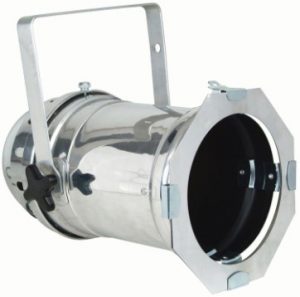
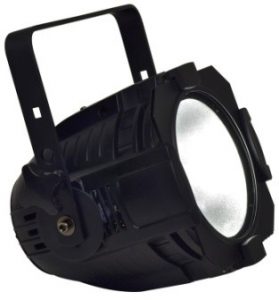
For illusionists, the PAR cans can be used to create colour chasers by chasing the colours or pulsing them in different order. Because of the colours, one can still create the lighting theme and ambiance with PARs, although this lighting is generally considered flat as there’s no movement and depth.
Function: Mood & Story Reinforcement
LED Wash
This is usually used for stage wash or general wash light, for talking acts. It is a flat uniform lighting. The normal colour used for stage wash is CTO (colour temperature orange) rather than white. This gives a slight tinge of orange to the wash colour and creates a warmer wash as compared to a stark white.
There are also other colour temperatures (colour temperature blue for example), but this is not usually used for stage wash unless under special circumstances.
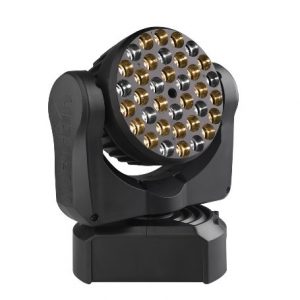
This is not a fixed fixture and its movement can be controlled from the lighting board.
As with most LED lighting fixtures, the great thing about the LED Wash is that the intensity and the colour of the light can be controlled from the lighting board. The light can be
Function: Visibility
Intelligent Lights
This is one of the most common lighting fixtures seen in showrooms and events alike. Depending on the purpose, the intelligent lights are usually used for stage wash or gobos. A gobo, derived from “Go Between” or “Goes Before Optics”, is a physical template slotted inside, or placed in front of, a lighting source, used to control the shape of emitted light.
This light is extremely versatile because the light movement can be controlled from the light board (hence it is sometimes also called ‘Moving Lights’ or ‘Moving Heads’).
Intelligent lights are awesome for illusion show because of the amount of movement and depth they can create.
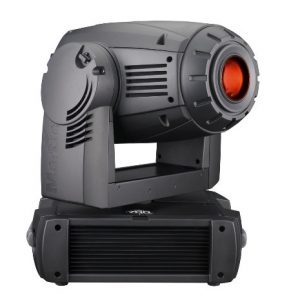
Spinning light rays and move and sweep across the stage can help to make an act look even more exciting due to the additional movement and depth. Using these correctly can make a show look exponentially better. At times you can also use the intelligent light to create a focused beam for a concentrated wash effect.
Function: All
Ellipsoidal Reflector Spotlight (ERS)
This fixture provides a sharp circular beam of light. This light is fixed and not adjustable from the lighting console board.

It is generally used for highlighting a subject and is used in conjunction with the stage wash to highlight the performer’s face.
For: Visibility & Focus
Fresnel
Fresnel (pronounced “Fre-nel,” with a silent “s”) is a fixture that provides a circular beam of light like the ERS but softer. Usually there are barn doors added to the Fresnel which helps to keep the lighting within the wanted boundary.
Due to the soft and wide beam of light, this is usually used in the general lighting of the stage area because of soft and wide beam.
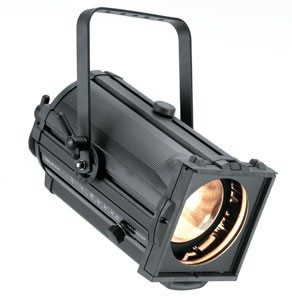
Similar to the Source Four ERS, this light is also fixed and cannot be controlled from the lighting console, hence found more in the theatre and auditorium setting.
In general for illusion shows, this is used for the stage wash for talking acts.
For: Visibility
Follow Spot
A follow spot is a large spotlight mounted on a tripod and is manned by a Follow Spot operator.
This light is used to track the performer on stage and “follow” the action as necessary. It keeps the audience’s attention focused on the performer but also allows some flexibility in lighting since it allows lights up the performer and a small area around him/ her.
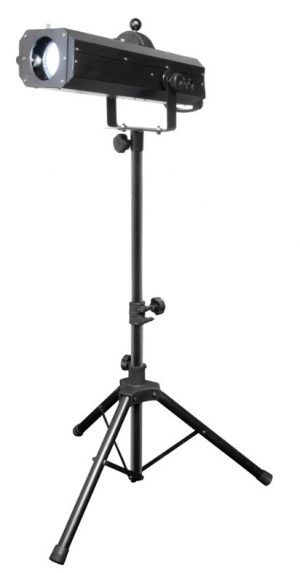
The intensity of the follow spot is important and the right size and strength of light must be appropriate for the venue. If the light is not strong enough, it will be ineffective in lighting the performer. If it is too strong, the performer can be totally burnt out.
Function: Visibility & Focus
One important consideration for theatrical lighting to show up well and look good is the need for smoke or haze to be present on stage. Without smoke or haze, even the most intricate lighting design cannot be seen or effective in enhancing a show.
Basic Lighting Cues
As a basic guide to lighting your illusion shows, here are 5 basic lighting cues that you should be familiar with.
Every show will have a lighting designer or technician who will program and operate the lighting boards. However, the technician will need input from you to design the best possible lighting for your show. It is good to have some basic knowledge on common cues.
A short glossary of terms is included at the end of this section.
Blackout
This is used for pre-show and post-show – usually to setup equipment on stage or strike. It also creates an air of mystery if you have a voice over introducing the show.
Stage Wash
When the performer is on stage and engaging the audience in a talking act or a transition between illusions, a stage wash is used to create warm brightly lit “neutral” stage.
This can be considered the “default setting” when no theatrical lighting enhancement is need.
Fast, Slow or Medium-Speed Chasers (or Light Pulses) with Movement on Stage
This is usually seen in non-talking acts performed to music. A combination of lights such as Pars, LED Pars and Intelligent Lights positioned on/ above the stage can be used to create a large array of chasing or pulsing patterns.
The speed of the pulses depends on the tempo of your music and the mood you want to create. You can also choose the colours that fit the theme or tone of your act to create the right atmosphere or energy.
Fast rhythms and cool colours create a cool and exciting feel. Slow rhythms with deep warm colours can convey suspense and danger. On the other hand, medium rhythms and multi-colours can create a happy and merry feel.
The permutations are endless and an experienced lighting designer will be able to create a sequence that best suits your needs.

Depending on the act, you can choose to have gobos (if they are using intelligent light) to create interesting patterns on stage or against the backdrop. If you are working with gobos, care must be taken so that the gobos are not too distracting. You can choose the pattern that best suits your act and also choose how well-defined and focused the patterns are. You can also select the patterns to move across the stage and rotate at a specified speed.
Note: if you do not have a Follow Spot, ensure that there is supporting stage wash so that the performer’s face is lit.
Back Lights to Create Depth of Field and Scale
An illusion show is all about scale and spectacle. Lighting is used to add to the scale. If you are working on a big stage, back lights can be used to create depth and visual scale. Multiple beams of lights (whether static or moving) can light up the back of props and fill up empty space behind props.


Focused Back, Top or Side Lighting
This is great for show reveals or the revelation of the a set at the start of an illusion. Focused spots from the top or back (or a combination) of the stage can create a very dramatic and mysterious feel. This sets the tone of an illusion and creates anticipation and suspense.
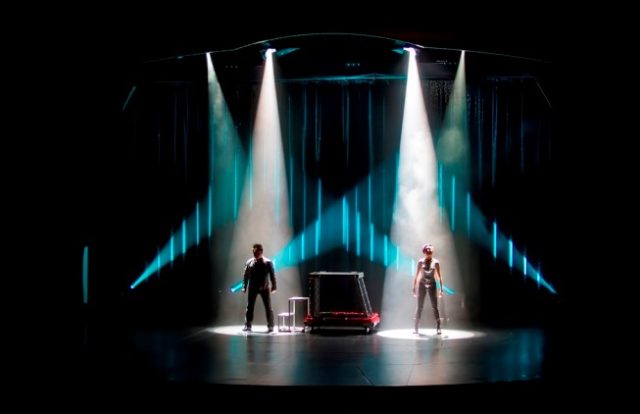

This cue can be used as the final cue of an act to create a dramatic applause cue as seen below:


Concentrated Wash
This is for any act where the performer remains in a specific spot on stage and does not have overly big or dynamic actions.
A concentrated wash cuts down the size of the stage and focuses it just on the performers, visually isolating the action on stage.
This can be very powerful to create a soft, enchanting and magical feel that contrasts against fast-paced dramatic illusions.
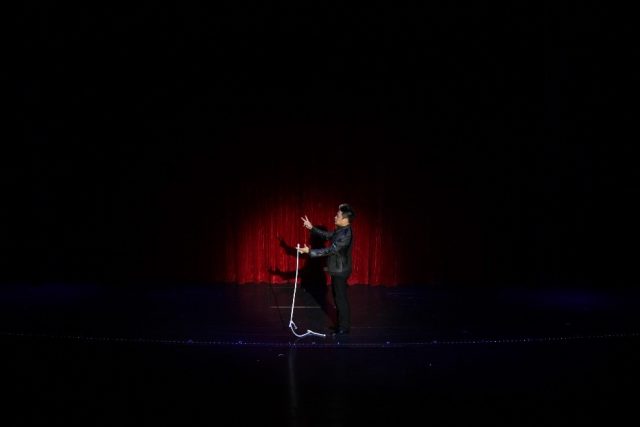

Here is an example from my show where I use video and lights to lead into an opening illusion at the start of the show:
Glossary
Blackout
As the word describes, it is a blackout, with no lights on. This can be used to announce the start of the show or as an effective transition before or after an act.
Stage Wash
Multiple light fixtures used together to wash (cover) the entire performing area with colour or pair of colour. Usually used for talking acts.
Concentrated Wash
Similar to stage wash, but concentrated in areas as determined. Usually used for a smaller act or to isolate the action on stage.
Special
This refers to one light focused on a limited area, not used in the wash. This is used to highlight a prop or to focus attention on a hand that extends out of a prop.
Chase
A sequential flashing of a series of light fixtures, usually used with a row of PARs or Intelligent Lights
Pulse
A non-sequential flashing of a series of light fixtures, usually used with a row of PARs or Intelligent Lights
Tilt/ Pan/ Swing/ Sweep
These terms describe the movement of the lighting created by the fixtures. Generally, only intelligent lighting fixtures have these capabilities.
DOWNLOADS
Sample Lighting Cue Sheet for Lighting Designer or Technician

