
LESSON 5: Illusion Show Structure
By this point, you probably have thought about which illusions you would like to perform and found a way to acquire them. In this lesson, we will explore how to produce a starting “worker’s” illusion show around those illusions.
THE WORKER’S SHOW
If you are breaking into the market with a show, especially as a new illusionist, you can be expect to have to perform your show in all kinds of venues and in all kinds of environments. In fact, as a new entertainer, most of your shows will unlikely be in theatrical venues but will be in event venues.
You can expect to perform your show in events and venues such as:
- Amusement Parks
- Associations Events
- Beaches
- Birthday Parties
- Cabarets
- Carnivals
- Child Care Centres
- Clubs
- Colleges
- Community Shows
- Consumer Exhibitions
- Corporate Events
- Country Clubs
- Entertainment Venues
- Fairs
- Family Events
- Festivals
- Football Fields
- Four-walling
- Hospitals
- National Special Events
- Nursing Homes
- Open Houses
- Outdoor Tentages or Marquees
- Parks
- Private Parties
- Public Open Houses
- Schools
- Shopping Malls
- Swimming Pool Areas
- Tourist Attractions
- Weddings
As such, as a new illusionist, you need to develop a worker’s show that can be performed almost anywhere in all conditions. Las Vegas magician, Jeff McBride, calls this a “Commando Show”.
Even when you reach the level of a headline entertainer where you are the main show and an event or venue caters to your needs and requirements so that you can stage your show, it is still useful to be able to have a “worker’s material” so that you can stage a good show under challenging conditions.
A worker’s show that can play to different audiences and in practically all conditions or at least have interchangeable material that can play in different performing conditions.
If there is one word in building your first show, it is practicality. This is not to suggest that the quality of performance or artistic standards should be compromised in any way. Putting thought and designing a smart practical show will go a long way in your career as it will teach you how to work in adverse conditions and make you a better performer.
Things to consider when designing your show include taking into consideration the:
- Type of Event or Venue
- Audience Size
- Audience Profile
- Stage Size
- Stage Wings, Backstage or Private Set-up Areas
- Position and Distance of Audience
- Set-up & Clear Off Time On/ From stage
- Load-in/ out Facilities
- Transportation Requirements
- Elaborateness and Time Needed to Set Up Show
- Budget/ Intended Show Fee
THE WORKER’S SHOW STRUCTURE
Very often, you will hear advice such as:
“Find a good opening, a solid closer and add fillers in between. Your opener should be attention-getting and short. Your closer should be the strongest act or routine you have.”
This is a basic good formula, although it is a bit too simple and too one-directional. However, it is a good starting point.
I developed my own magic show from observing other performers as well as reading the limited literature there was on the subject of show production. I learnt a lot from Denny Lee’s lecture notes. While modest in length, the notes were inspiration and offered very practical advice.
Over the years, I built on what I learnt and developed my own show formula. While my original model was designed for a magic and illusion show, I have successfully used the approach to produce all kinds of live shows for fire artists, escape artists, balloon performers, jugglers and variety shows that have included singers and dancers. So, this is a time-tested and proven formula.
Depending on your market and performing venues, an illusion show can run anywhere from a 10-minute act to a 90-minute full evening theatre show.
There are no rules to the maximum number of illusions in a show as you will ultimately be limited by your own illusion repertoire, stage size, backstage size and availability of crew. However, depending on the duration of the show, you probably need at least 2 illusions for the show to be considered an illusion show.
Most of my shows are between 30min – 75min. I have never done a show with more than 10 illusions in a single show. Here is an indicative guide of what I think will fit most illusionists:
- 30 min Show: 3 – 4 Illusions
- 45 min Show: 4 – 5 illusions
- 60 min Show: 6 – 7 illusions
- 75 min Show: 7 – 8 illusions
For purposes of this course, we will work towards a manageable 30min show.
Now, a 30-minute show does not mean that you have to perform a show only consisting of illusions. Only the biggest illusion shows feature illusion after illusion in a single show and often, the show is peppered with stage acts, stand-up routines and even close up routines filmed with a camera on a live video feed projected on a large screen.
As a starting point, I suggest producing your show with three illusions in mind. One will be the opener, one will be the closer and one will be the middle illusion.
The general formula for an illusion show is to alternate between an illusion with a stand-up or silent stage piece. This creates variety in the show and is also a practical structure as it allows the crew to set the stage for each illusion number.
Most illusion shows will open with an illusion or an impressive silent stage magic act that leads to an illusion. Many times, the silent stage act is performed first because of the loads and pre-sets needed.
Most illusion shows also close with an illusion, although it is also common to close with a sentimental stage piece to end on an emotional high, as opposed to a visual spectacle. I have used both types of performances to end an illusion show.
Some illusions naturally work better in a specific position in the show. If all illusions work well in any of the positions, consider the “mess” that the illusions may leave on stage after performing it. For example, some illusions might leave swords or cloths littered on the stage after the performance. It is best to have such an illusion positioned as your finale so that the stage hands can clear the stage after you end your show.
With the above in mind, you will be able to structure your illusion show. This is the structure I have used to produce all my shows (whether for myself or other talents) for the past 20 years. It is a formula that has proven to work for all markets across the world. Of course, it is not the only way to structure a show but it is a good template for you to start with.
Show Format
Here is an outline of a sample 30-minute illusion show:
The Opener: Visual Stage Magic and Illusion #1 (3min – 5min)
Introductory Stand-up/ Stage Routine(s) (2min – 4min)
Illusion #2 (3min)
Audience Participation Routine (5min – 8min)
Short Stage Magic Routine (2min)
The Closer: Illusion #3 (3min)
I feel that the above format gives the audience a good variety of effects, moods and an overall complete entertainment experience.
To put the above show format in context, let me describe a show with actual illusions/ effects and I’ll give my rationale on why I place specific effects/ illusions at specific points of the show.
For the sake of clarity and so that illusion novices can relate to the material, I deliberately chose ‘standard’ effects that most magicians will be familiar with to make up the show content.
The three illusions featured in the show will be a Ralph Adams-style ‘Sword Basket’ mounted on a table and uses fire torches and a large sword, the ‘Zig Zag Girl’ and the ‘Substitution Trunk’ with all-round curtain and double costume change kicker.
The Opener: Visual Stage Magic and Illusion #1 (3 – 5min)
Keeping in mind the objective of the opener, the opening act features visual magic & illusion that use fire. Illusion #1 is the ‘Sword Basket’ using fire torches and a large sword for the center hole.
The music soundtrack begins and the opener starts off with the stage darkening except for a follow spot light and smoke filling the stage. The illusionist takes the stage and performs a ‘Torch to Cane’ followed by a ‘Double Torch Production from a Foulard (cloth)’. Next, a ‘Fire Drawer Box’ is used to produce the ‘Sword Basket’ cloth.
The opener climaxes with the ‘Sword Basket’ performed with an assistant and ending with finale pose to the end of the music track.
Rationale: Fire is a great attention-getting device, highly visual and plays big. It also links the effects thematically. The ‘Sword Basket’ extends the ‘fire’ theme to a larger effect and has a definite ending to signal the climax of the opening act.
Introductory Stand-up/ Stage Routine(s) (2min – 4min)
The illusionist performs a mass audience participation effect, ‘The Grey Elephant in Demark’, to establish his relationship with the audience, showcase his personality and warm the audience to him.
He then magically produces a bottle of champagne as a toast to the audience.
Rationale: These items are designed to introduce the illusionist to his audience to retain their interest for the rest of the show. The mass audience participation effect allows the illusionist to interact (to a certain extent) with everyone in the audience and make them feel part of the show.
The production of the champagne bottle is a quickie and is appropriate for most events. Toasting the audience adds a nice touch in communicating sincerity to the audience.
Illusion #2 (3min)
The illusionist patters that magicians have been cutting girls in half for a hundred years. He explains that he will put a twist on that illusion and cut a girl into three pieces. He then presents the ‘Zig Zag Girl’ performed to music.
Rationale: The second illusion is placed in this part of the show as a follow-up to the illusionist’s introductory patter and smaller effects. It ‘re-establishes’ the performer as an illusionist and the illusion performed to music allows the audience to sit back, relax and enjoy the performance, without thinking too much.
Audience Participation Routine (6min)
The illusionist invites an audience member onto stage and performs a ‘Signed Bill in Lemon’ with loads of audience interaction and situational comedy.
Rationale: This entertaining audience participation routine allows the Illusionist to showcase his personality and interaction with the audience even more. Although a smaller stage effect, the audience interaction and comedy in the routine makes it a highlight in the illusion show. Plus, the ‘Signed Bill in Lemon’ is also a very strong effect.
Short Stage Magic Routine (2min)
After the ‘high’ created in the previous audience participation routine, the illusionist slows things down by performing the first piece of magic he ever learnt. He then goes on to perform a ‘Torn & Restored Newspaper’ with a flash restoration.
Rationale: This is a short piece designed to slow things down from the excitement created by the audience participation effect and allows the audience to ‘catch their breath’. It is also an important set-up effect to the closing illusion that follows. A smaller piece that builds towards a larger illusion makes the illusion that much more significant.
The Closer: Illusion #3 (3min)
For the finale of the show, the illusionist patters that he will perform an illusion as tribute to Harry Houdini. It combines escape, suspense and the fastest feat of magic, all in one single grand illusion.
In the tradition of Houdini, the illusionist performs the illusion not with a fancy Las Vegas illusion prop, but with a solid packing crate built from solid timber and 2” steel nails. He presents the classic ‘Substitution Trunk’ but with an added double costume change kicker of his assistant and himself.
Rationale: The ‘Sub Trunk’ is chosen as the closing illusion as it is the strongest illusion (if performed well) among the three illusions featured in the show. Although the patter may be a slight bend of the truth, the use of a simple packing crate-style prop creates contrast, interest, intrigue and an overall stronger illusion. The double costume change adds a punch to clearly signify the finale of the show.
I hope this example gives a clear idea on how to structure and organize your material to produce an illusion show. If you are putting together your first Illusion Show, I recommend that you use this format as your first blueprint and modify it as necessary to suit your specific needs, event conditions and audience.
Watch two of my full 45-minute illusion shows below. These are not “worker’s” shows but are shows that I perform regularly.
The first show is when I worked with a partner and the second show is my current solo illusion show that I have performed since 2013.
Note: The two show videos below cannot be downloaded have to be streamed to watch.
Password: unlockjcsumsolo
INNOVATIVE ILLUSION SHOW CONCEPT IDEAS
Most illusion shows follow a similar formula: Open with an illusion, then alternate between stage/ stand-up routines till the climax which is the biggest or most impressive illusion.
The worker’s show I described above follows this structure as it is safe and I highly recommend you start off with this type of structure. In fact, I would say most of my general shows follow this structure although I have distinct changes in theatrical pacing in the two halves of my show.
However, there are gigs where a more bold and innovative show structure or concept can be explored. Over the years, I have produced and staged several concept illusion shows that worked for the projects I was working on at that time.
Here some ideas to get your inspired in possibly thinking about a different show structure or concept for your illusion show.
After you work out the format for your first illusion show, you can consider alternative show concepts, depending on the venues or gigs you perform for. Sometimes, there are gigs where a more bold and innovative show structure or concept can be explored.
Over the years, I have produced and staged several concept illusion shows that worked for the projects I was working on at that time. To get your creative juices flowing, here are five possible show concepts for your illusion show.
Storyline/ Plot
This is one of the most straight forward devices to give a concept to an act or show. The show is presented as a story with the magic & illusions supporting the story. This is quite popular in Europe, especially for shows that play in theatres.
Storyline short acts are more common than full magic & illusion shows with a central storyline.
Good scripting and direction is required to make any storyline concept work. Production value in terms of stage sets, costumes, props and lighting might also be required to create the right theatrical experience.
Some magicians and illusionists also draw on their own lives and perform illusions and effects that represent symbolic moments in their lives.
One story concept that I have not seen used (to my knowledge) in an illusion show is the Murder Mystery plot. This is like a game of “Clue” or a “Who Dunnit?” show. A crime of sorts is committed and the storyline advances the plot. At the end, the murderer or criminal is revealed, usually with a twist ending.
This plot can be made into an interactive show where spectators are assigned roles and the audience has to guess who the murderer or criminal is. Naturally, magic effects & illusions are used to tell the story.
Themes
A common show concept is to build the show around a theme. The themes are limited to your imagination and creativity. A non-exhaustive list of themes includes; danger, fear, science, recycling, horror, technology, history, culture, pop culture, music or a specific era.
For a themed show to be successful, the theme should have value, meaning, relate to the audience or have a motivation/ consequence for the presented magic effects.
Please… for the love of all good things magical… Please do not build a show around a frivolous theme like a single colour. The Yellow Magician might appeal to kids for birthday party shows but does not have a place in a modern illusion show, in my opinion.
A Story Arc Effect
This approach is akin to the concept of a running gag but with a big magical payoff at the end.
The audience’s attention is constantly called towards an item on stage and finally something happens to it at the end of the show.
Here is an example:
At the start of the show, the illusionist calls attention to a padlocked-trunk on a table/ raised stand at the side of the stage. He explains it contains something important that he will reveal to the audience at a later time.
Throughout different points in the show between routines, different items are vanished including a cage of doves, a spectator’s watch, a bottle of wine and eventually a girl.
Each time an item is vanished; the illusionist calls out a seemingly random single-digit number and asks the audience to remember the numbers as the show progresses.
So after the fourth item (the girl) vanishes, the illusionist calls out a fourth number and finally asks the audience to call out the four numbers. E.g. 5928
These four numbers are revealed to be the combination that opens the number padlock of the trunk. When the trunk is opened, the (vanished) girl reappears holding a birdcage in one hand, a bottle of wine in the other and the spectator’s watch around one wrist.
This is an example of a story arc effect that I came up with but knowledgeable illusionists will be able to devise various methods to achieve this effect.
Another example of a story arc effect presented in a close-up routine is Paul Gertner’s “Ring on Hourglass” effect that is the wrap-around effect that ties his act (of separate effects) together described in his book/ DVD “Steel & Silver”.
Different Versions of the Same Effect
This is an intriguing concept but requires skill and careful thought to pull off well.
This concept can be intriguing to an audience only if presented well, otherwise it will come across repetitive and mundane.
From a magic deception perspective, the benefit of performing the same effect with different methods and presentations is that they will cancel out the methods of the illusions in the minds of the audience.
The idea is to present different versions of the same effect in a single show. While it is unlikely it will work for a long show, say 30min or more, it will work for a 15min show or as one half of a fuller show.
For example, you may want to perform a series of progressive suspensions and levitations that increase in strength of effect and deceptiveness. So, you might start with a “Broom Suspension”, then a “Ladder Levitation” and finish with an “Asrah Levitation” that ends with the kicker vanish of the girl.
One idea I came up with years ago was to present different sawing illusions such as the “Thin Model Sawing”, “Modern Art” and “360 Sawing” as one themed segment in a show.
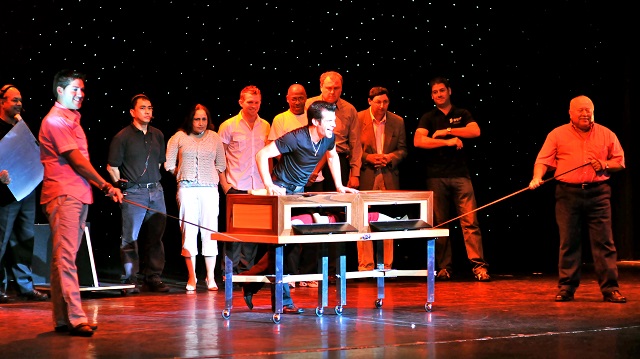
Not surprisingly, I’m not the only one to think of such a concept. This very “sawing show” was presented by several well-known magicians at Magic Live! 2011. It featured different sawing illusions performed in succession including David Charvet as Harry Blackstone Jr presenting the “Buzz Saw”, Mark Kalin & Jinger presenting the “Wakeling Sawing”, Kevin James staging his original “Operation” illusion, Jonathan Pendragon performing his “Clearly Impossible” and Greg Wilson performing his parents’ (Mark & Nani) “Training Sawing”.
Build Up to One Big Stunt
This technique is most commonly used on TV magic shows where the episode or special ends with a big illusion or stunt. Throughout the episode, different elements of the stunt are highlighted or clips of preparations/ training are shown. Often, parts of the props or set-up are also introduced. These elements are used to hook the viewers and keep them captivated so they stay to the end of the show.
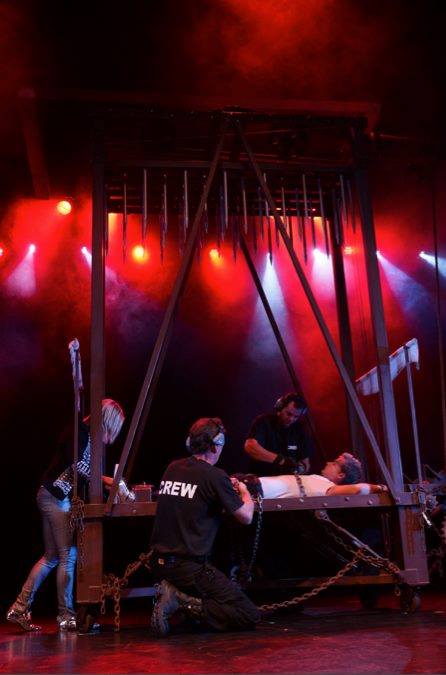
The same technique can be used for a live show. For example, if you are going to close your show with Andre Kole’s “Table of Death”, you can do any of the following between routines as a build-up in your show:
1) Show off a spike from the “Table of Death” or the shackles/ cuffs that will hold you down.
2) Perform a lock-picking demonstration to show how you intend to escape from the “Table of Death”.
3) Show a short video clip of you preparing for the stunt if video screens are available.
4) Perform a “Spike Through Balloon” or similar stage effect to illustrate an illusion with a spike. However, state that what you will be attempting with the “Table of Death” is not an illusion.
The same technique can be used for a live show. For example, if you are going to close your show with Andre Kole’s “Table of Death”, you can do any of the following between routines as a build-up in your show:
If you try out any of the show concepts for your show, let me know how it goes.
REFERENCE
Prop Movement & Stage Management are essential to execute a good illusion show, regardless of the structure of the show. Read page 184 of “How to Be an Illusionist”.

