
LESSON 2: Choosing Your First Illusion
In this lesson, we get to the core product of being an illusionist and that is the physical illusions themselves as well as the different props required to perform the illusion act/ show.
Experiment with Simple Illusions
After you have acquired wide-ranging knowledge on the various aspects of illusions, you can start experimenting with simple illusions. By that, I mean experimenting with some basic illusion principles and techniques using items that you can obtain cheaply. This includes constructing illusions from cardboard, cloth, PVC pipes and other easy to obtain material.
If you have not, request for my FREE illusion plan at illusionbooks.com. This is an illusion that is relatively easy for you to put together if you have a basic workshop. It will also teach you how to work and present illusions as well as work with assistants. In additional, you can get access to the Backstage Section of the website that details several more illusions that you can build.
Grant’s “Victory Cartons” book, Mark Wilson’s “Complete Course in Magic”, “Mark Wilson on Illusions” as well as Andrew Mayne’s various booklets and “Illusion EFX” DVD all contain illusions that you can make inexpensively with literally cardboard boxes and duct tape.
These inexpensive illusions will allow you to experiment with various illusion techniques like protecting angles, choreography, movement, teamwork, working with large props and pantomime. Film your “experiments” with your smart phone, a cheap video camera, or web cam and observe your routining, movement and illusion handling.
Besides honing basic illusion techniques through experimenting with simple illusions, this exercise will help you find your inclination and strengths towards certain illusions. This will also help you start to develop your illusion style, may it be a physical style like Hans Klok, dramatic like Copperfield or patter intensive and comedic as opposed to silent with pantomime.
Choosing Your First Illusion
Once you have experimented with simple illusions and you think illusions are for you, you will want to acquire a professional illusion prop.
In Nov 2012, I completed a 5-week 21-city “3 Sides of Magic” lecture tour in France, Holland, Belgium, Switzerland and Germany. While my lecture covered my professional work in close, mentalism and cabaret magic, I devoted one segment of the lecture to grand illusions. Specifically, I discussed what would be a good first illusion for a new performer to illusions or for a close-up or stand-up magician who has been asked to stage a large-scale act for a special show.
Identify the Level of Your Performance
The first thing you need to do is to identify the level of your performance for this first illusion. For lack of better terms, I will distinguish between a professional and an amateur performance for purposes of this discussion.
I define a professional performance as a paid gig where you are engaged as a professional entertainer to perform for an audience. For an amateur performance, you may be paid a token sum of money but not a professional fee. This performance might be for a friend’s function, wedding, school show, church event, magic club show or charity event.
This is by no means looking down on amateur performances but it is to highlight the necessity for stricter criteria when choosing your first illusion for a professional gig as expectations from the client/ audience are different.
For professional performances, you have to fulfill a certain expectation of the client who booked you or your paying audience if you do your own theatre show. They will be more critical of your material, performance and overall show production value. Overly common illusions performed with little original style may not be enough to impress your paying audience.
Your illusion (and the rest of your show) should look professional. I am not saying that it has to be a chromed industrial-looking prop or a painted box, but an old card box put together with fraying duct tape will not make the cut for most professional performances. The exception would be if you were using a “beat-up” prop amidst a professional illusion set to create contrast.
If your illusion is for an amateur performance, you will have slightly more latitude in the look of your props, standard and originality of performance; although I am not implying that artistic quality and standards should be compromised. Makeshift props fabricated with careful detail out of cardboard ala U.F. Grant’s “Victory Cartons” or Andrew Mayne’s “Voodoo Box” will be good enough.
Practical Considerations
After taking into account the level of performance that you are staging, basic and practical considerations when choosing your first illusion include:
- The illusion must complement your performing style and character.
- The performing venue & conditions – size of stage, private backstage area, side wings.
- The audience seating angles, sightlines & audience distance.
- Your mode of transportation – car, MPV, van, lorry, public transport etc.
- Your illusion budget.
- Your support crew – availability of illusion assistant(s), stage hands, secret assistants.
The 3 Most Common “First” Illusions
Here are the three most common recommendations for a first illusion.
The Substitution Trunk. This is a classic Houdini illusion where the magician is locked into a box or trunk. The assistant stands on top and raises a curtain. Split seconds later, the performers exchange places with the magician standing on top of the trunk and the assistant inside the trunk.
The Broom Suspension. Created by Robert Houdin, two brooms are placed vertically under a girl’s arms. The girl’s legs are lifted up horizontally so her body is parallel to the ground. One broom is removed and the girl magically suspends in the air on one broom.
A Box-style Illusion. This refers to any “box jumper” illusion where a girl goes inside a box and the box is speared, stabbed or divided. Examples of such illusions include the “Sword Basket” or “Sword Box”, Robert Harbin’s “Zig Zag Girl”, Jim Steinmeyer’s “Modern Art”, Gunther Puchinger’s “Mini Kube Zag” or Jack Gwynne’s “Sword Temple” (also known as the “Temple of Benares”).
These are all excellent illusions in their own right as they are relatively inexpensive, can pack flat or fairly small and can be performed in most conditions.
While we agree these are all great illusions and good starting illusions, not all three are ideal as the very first illusion, especially if you are an occasional performer, part-time professional or weekend warrior. The “Substitution Trunk” and “Broom Suspension” are not ideal first illusions.
The “Substitution Trunk” is not a good very first illusion as it requires a lot of time to learn and eventually perfect. It is extremely difficult and physical in nature. If you are not a full-time magician or not full-time into illusions, it is unlikely that you can devote a considerable amount of time to practice and rehearse. Realistically, you may have only two to three days of two hours each to rehearse. And, you would have to coordinate your schedule with your assistant who is not likely to be your full-time assistant.
The “Sub Trunk” requires weeks of rehearsal just to perform it smoothly, as such, it is not an ideal first illusion although it is a fantastic illusion for a subsequent illusion after you have some experience in illusions.

The “Broom Suspension” is not an ideal first illusion for several reasons. First, the method requires a harness that should be custom fitted to your assistant. So, you will need to use the same assistant each time or an assistant of very similar build.
The illusion also requires the assistant to have strong abdominal and thigh muscles to keep her body straight during the suspension so that the illusion will look good. If this is your first illusion, it is unlikely that you will have a professional dancer or assistant. You will likely be asking your wife, girlfriend, daughter, mother or grandmother to assist you. If they are not trained dancers or fitness instructors, chances are, they will find the illusion very difficult and even painful to perform. The experience will not be positive and they may not want to assist you after your first rehearsal.
There is another reason why the “Broom Suspension” is not ideal as a very first illusion – the lack of production value. When a client books an illusion show, they expect to see big illusion props and flashy costumes. While it is a cliché and, as magicians, we know that the prop does not represent the quality of an illusionist, laymen clients are different. They expect production value and this value is directly proportionate to the money they pay. A “Broom Suspension” unfortunately does not have tremendous production value as the main props are two brooms. If this is the only illusion you perform in an illusion show, it might not fulfill your client’s expectations.
This does not mean the “Broom Suspension” is not a good illusion because it is very effective in the right context. If you perform a full illusion show with multiple large illusions, the “Broom Suspension” is an excellent illusion to put in the middle of the program.
Once you have established yourself as an illusionist with the “big toys”, you explain to the audience that you would like to present an illusion with some ordinary items that you found backstage. You then bring out the brooms and present the “Broom Suspension”. In this context, this illusion plays very well and no client will have an issue with it in terms of lack of production value.

So, the best first illusion to perform is a box-type illusion. Firstly, the box illusion is also a large prop that will satisfy clients looking for production value. Most box illusions can fit different sized girls so it does not have to be precisely custom-fitted to your assistant.
You can also learn most basic box illusions in one session of two hours and later make the performance smooth with a few more sessions. Your assistant and you can work out the basic choreography of the illusion and the order of movements in a relatively short time.
Finally, a box illusion will also teach you basic illusion presentation skills, movement, prop handling and choreography. This will help you in the performance of future illusions.

One important point to note about box illusions is that it is very easy to perform them badly. You often hear the criticism that illusionists are “box pushers”. This is because many illusionists (professionals included) perform box illusions very badly.
There are many aspects of a box illusion performance that are easy to perform badly that affect the entire performance. Besides badly designed props that are ugly and not deceptive, the performance of a box illusion contains many non-magic actions that are not magical moments but are necessary for the performance of the illusion.
These include non-magic actions such as opening/ closing a door to a prop, removing a cloth, turning a prop around, taking swords/ spears/ tubes from a stand or stage hand or moving panels, illusion parts or catches.
Many performers do not think about how to present such non-magic actions. As a result, these actions are performed without thinking how they look or take too much time to perform. Every non-magic action has to be well thought out and choreographed. The actions must be performed smoothly and with economy of action. That means that any single action should be accomplished with the least amount of movements.
In any single illusion performance, there can easily be ten non-magic actions to perform. So, it is critical to ensure these actions are short and look elegant so that the entire illusion performance will be polished and professional.
Considerations When Selecting Illusions
Here are some basic considerations to take note of when choosing illusions, especially for event performances which are likely your first performing venues:
Sightlines/ Angles / Distance
The audience seating (or standing) layout may be never constant, especially for events like carnivals, mall shows or small corporate events. Your illusions may need to be as angle proof as possible. If the illusions can play surrounded, that’s great. If not, they should at least be able to play well to three sides. Most events would have a backdrop on stage, so that protects your rear angle.
If you play in venues where the audience is at a higher plane than the stage and looking down, such as a theatre with balcony seats or a shopping mall, you need to make sure the illusion is protected from the top as well. Thus, a “Sub Trunk”, even with an all-round curtain, would not be a suitable illusion in this case.
Distance is also an important factor. Some illusions have to be viewed from a distance to be deceptive. In some venues, there are times when the audience can be as close as just 8 feet away. You must make sure your illusions can stand up to such close up scrutiny. Illusions that utilize black art, prosthetics or mirrors may not play well if audiences are too close or at odd angles.
Audience Profile
Your audience profile and booking client will also determine what type of illusions you stage. If you are a corporate entertainer who performs for international corporate audiences who have seen it all, a standard “Sawing in Half” or “Sword Cabinet” will unlikely be good enough for demanding clients. However, the same illusion could play perfectly for other shows.
When it comes to family shows, many may want to avoid gory illusions or themes that have violence in them. I personally am not averse to performing more ‘dangerous’ or ‘scary’ illusions that may involve swords or knives. Of course, I will qualify the performance of the illusion and announce that the kids should not try anything like this at home. However, I do understand this depends highly on the culture of your country and community. I will leave it to you to decide what is acceptable and suitable for your own shows.
I personally do draw the line when it comes to using material that is off-colour or contains racial themes, unless your show or venue specifically requires it.
Size & Weight of the Prop
One important point to consider when selecting your illusions is the size and weight of the prop. This is largely dictated by the shows you work, the size of your crew and your mode of transport.
If many of your shows are performed on portable stages, the weight of the prop cannot be too excessive. If the venues you perform at are unlikely to have big stages, large-scale illusions like Andre Kole’s “Table of Death” or a car appearance will not be practical to stage.
Not all venues or events will have backstage areas the same level as the stages like most proscenium theatre stages. This means illusion props cannot be wheeled out directly from the side-wings but have to be carried onto stage just before your performance.
From a practical logistical standpoint, large and heavy props mean that you would need a sizable crew and appropriate mode of transport to move your props to the show.
Access to your performing stage is also a consideration. If you perform in schools, it is highly possible that there are no lifts large enough for your illusions. That means you may have to carry your props up two flights of steps to get to the auditorium, gymnasium or multi-purpose hall.
Having said the above, I do not necessary subscribe to the ‘pack small, play big’ philosophy whole-heartedly. I believe in packing as big as necessary for the type of work you do.
As a commercial performer, many times it is just pure economics, if you charge $1000 per show but it costs you $200 to rent a truck, $300 to pay your crew and it takes you two hours to set up your show, you are probably better off just doing a stand-up show for $500. However, if you charge $10,000 a show, a certain amount of inconvenience and cost will likely be necessary to justify part of your fee to your client.
Ease and Speed of Setting On/ Off Stage
Before choosing your illusion, you need to be aware what sort of stage you will likely be performing on. The two main stages that you will encounter are:
- Proscenium Stage
- Open Platform Stage
Proscenium Stage

This is the typical stage you will find in a showroom, theatre or auditorium. The A proscenium is the area of a theatre surrounding the stage opening. A proscenium arch is the arch over this area. The proscenium is separated by a main curtain that comes from behind the proscenium arch.
There are typically side wings on each side of the stage and a backstage area behind the back curtain of the stage. The size varies from venue to venue.
With most proscenium stages, you will be able to store illusions in the side wings and they can be brought onto stage when you need them. Props can also be set behind the main curtain as you perform an “in-one” piece in front of the curtain.
Open Platform Stages

For most event settings or shows in a hotel ballroom, mall, carnival or festival, you might be performing on an open platform or thrust stage. While there may be a backdrop for this stage, there are no side wings where props can be wheeled out directly on stage, unless specifically built and catered for.
In event performances, the expectation is for you to set up and clear the stage efficiently and as quickly as possible. It is important to understand that your show is unlikely the only activity happening on stage during the duration of the event. Speeches, award presentations and other entertainers will likely share the stage with you.
There are no front curtains where stagehands can set up elaborate illusion set-ups that need extensive stage rigging, special staging and backdrops. At best, you can get a stage blackout if your event has the lighting capabilities. If you are performing for a carnival or shopping mall, you have to set up your show in full view of your audience, in full light. This means, you cannot have any secret hook-ups or set-ups that are usually set on stage behind the front curtain.
On this type of stage, your illusions may have to be carried onto stage before your show and will be visible on stage throughout your show.
I am not a fan of having the illusions on stage throughout the show but sometimes it is a necessity.
Tips for a “First” Illusion
Here are some final first-illusion tips:
- If you do intend to purchase or build a standard or common illusion, create a different and enhanced presentation or variation. This will help you make the illusion look different and is a good creative process that will help you develop future illusion presentations.
- Do not get short-duration illusions as your first and only illusion. If you are performing your first illusion, it will likely be the closer for your show so it has to have a substantial effect in content and duration. An instant appearance may look good but if it takes only 30-seconds to perform, it will not be suitable.
- Choose self-contained illusions that do not require a pre-load. If you choose an appearance illusion where your assistant has to be loaded, then you have to perform it at the start of the show. If you are not performing on a proper theatre stage, you may also not even have stage wings or a private area where the assistant can be secretly loaded into the prop. Illusions of this nature include a “Flash Appearance”, “Fire Cage” or “Shadow Box”.
- Instead of performing one big illusion, you can also consider performing several small illusions or illusionettes like “Dagger Head Chest”, “Head Twister”, “Torch through Arm”, “Sword through Neck”, “Arm/ Head Chopper” or “Chair Suspension”. These are all time-tested mini illusions that are affordable and easy to perform.
THERE IS NO ONE ULTIMATE PERFECT ILLUSION
This is a very important concept to embrace.
The perfect illusion is the Holy Grail for illusionists. Most illusionists are constantly seeking for the perfect illusion. They believe that ONE illusion will propel their careers to superstardom and lucrative performance contracts.
As a result, they spend a lot of their time searching for this elusive illusion that will define their career.
After 15 years of performing illusions and looking for my own perfect illusion (at times), I have come to two conclusions:
- There is no ultimate perfect illusion but there are perfect illusions that will fit YOU at different stages of your career.
- No ONE perfect illusion will make your career. Your career will be defined by your body of work over a sustained period of time.
You need to look for the perfect illusion that fits you at a specific point in your career. I started out my illusion career with a sword basket-type illusion. This was the perfect illusion for me at that point in my career for many reasons:
While a commonly-performed illusion worldwide, no one was performing this illusion in my country or even in the region. In fact, there were hardly any world-class illusionists in Asia at that time.
Practical reasons included not being able to justify expensive illusions based on my then-show fee. I also worked only with an assistant and traveled by car so everything had to fit into the backseat and boot. I also worked from home so did not have storage space for large props and cases.
As I’ve discussed above, the sword basket is an excellent illusion as it is regarded as a “box illusion”.
A box illusion will also teach you basic illusion presentation skills, movement, prop handling and choreography. This will help you in the performance of future illusions.
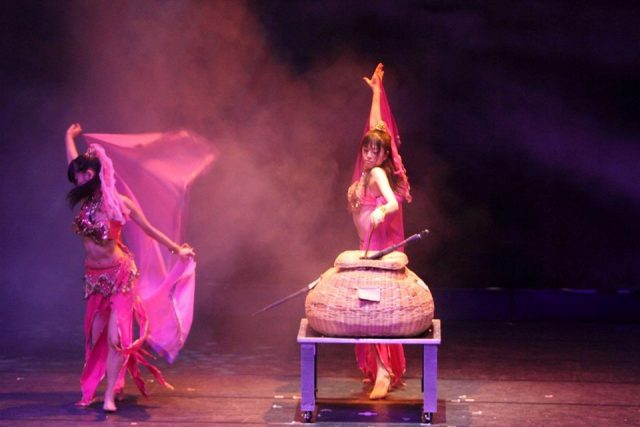
For example, the performance of a box illusion contains many non-magic actions that are not magical moments but are necessary for the performance of the illusion. These include non-magic actions such as opening/ closing a door to a prop, removing a cloth, turning a prop around, taking swords/ spears/ tubes from a stand or stage hand or moving panels, illusion parts or catches.
Working with a box illusion will help you think about how to present such non-magic actions. Every non-magic action has to be well thought out and choreographed. The actions must be performed smoothly and with economy of action. That means that any single action should be accomplished with the least amount of movements. In any single illusion performance, there can easily be ten non-magic actions to perform. So, it is critical to ensure these actions are short and look elegant so that the entire illusion performance will be polished and professional.
As my career progressed, I needed more sophisticated and unique illusions so my efforts went in that direction. And, the process cycle has repeated itself over the course of my career.
REFERENCE
Start building your illusion knowledge with an Overview of Over 100 Popular Illusions Performed by Modern Illusionists Today on page 33 of “How to Be an Illusionist”.

