
LESSON 15: Marketing Tactics & Ideas
This is the final lesson of the Professional Illusionist Master Course. I hope you have found value in this course and have learnt all the different aspects of being a professional illusionist in order to succeed in the live entertainment industry.
Remember, “Show Business” is two words and you have to put equal focus in both aspects of your work, the “show” and the “business”.
This final lesson covers specific marketing tactics and ideas you can use right away to book more shows as well as bigger and better shows.
All the best!
TARGETING YOUR MARKET – NICHE MARKETING
This is a cornerstone of the “Big Money Approach” as outlined in my book “Think BIG (Money)” which was available as a download in the Lesson 13.
As an entertainer, your product (your act) is fundamental and is your defining quality. However, as a commercial entertainer who performs for money, the right approach is to first examine your market viability and potential business opportunities.
It is the understanding of your market opportunities that guides the creation, presentation and marketing of your product. Most entertainers work the other way around.
The most common approach is for an entertainer to work on an act first and then try to find work with the act. This is the traditional way.
The problem with this approach is that there is a large possibility, especially in today’s market, that you might have an excellent act but no viable market to perform it in. You want a market that will give the desired financial returns for all the time, effort and skill required to perform the act.
This is one reason why some entertainers are not as successful as they can be or why some businesses fail in general. They fail to research the market and end up creating a product that does not have a place in the market or does not add great value to the market.
One key to being successful is to identify a niche market that is unsaturated and try to own it.
A niche market is a specific market within a larger general market that has specialized needs. It is a subset of the general market, also known as a small segmented market.
Niches do not ‘exist’ but are ‘created’ by identifying needs, wants, and requirements that are being addressed poorly or not at all by other product or service providers.
That is an important characteristic – niches do not ‘exist’ but have to be identified by you.
As a strategy, niche marketing is aimed at being a big fish in a small pond instead of being a small fish in a big pond. It is also known as micromarketing.
Examples of niche market products include the hundreds of cable TV stations as well as thousands of podcasts and websites that target specific audiences of specific interests and tastes. Each audience represents its own niche market.
So, all the podcasts on the Internet form the general market. However, podcasts discussing sports is a niche (subset) of the general podcast market. Podcasts discussing a specific sport such as mixed martial arts is an even more niche market.
Entertainers who specialize only in wedding entertainment and know this type of event inside out serve a niche market. The same goes for entertainers who work on festivals and fairs.
This master course in itself is targeted at a highly niche market. General information and trade courses are available to wide general markets. But a course written specifically for illusionists based on the specific needs and nature of the live entertainment industry is a highly niche market. The course is highly valuable to the illusionists (not even general magicians) in this niche market yet has little value to people outside the market. But, that is the nature of a niche market.
Your job is to identify a potential niche or segment that is untapped. Look for markets that illusionists have not explored or do not have high competition.
Remember, niches do not ‘exist’ but have to be identified by you. It is possible that a niche market has been created by someone else but they are not serving the niche adequately. You can take advantage of that and bring more value to the niche market and potentially “steal” it away.
This does take some creativity and thinking. It may not be intuitive and may require much effort for you to consider all types of angles. You are literally trying to identify an opportunity that no one has capitalized on before.
The good news is that as an entertainer, you are a creative individual! That means you have the capacity to identify a niche market if you gear your mind towards it.
MARKETING TACTICS & IDEAS
Hopefully, you have given some thought on the markets you intend to target and book your illusion show in. When creating your promotional material, it should always be designed with your target market(s) in mind.
After you have created your promotional tools such as your photographs, videos, profile, show program/ information and website, it is time to promote these tools as many people as possible.
Word of Mouth Marketing & Referrals
Start with your existing friends and family. Get them to refer you to other friends or business acquaintances. Next, if you have an existing pool of clients who already use your other magic services, upsell them your new illusion show.
As an entertainer, especially if you are new to the industry, referrals or ‘word of mouth’ marketing will be one of your most effective marketing tools. A positive referral or recommendation is far more effective than any marketing you can do to sell a prospect your show.
If you have an excellent product, satisfied clients will naturally rave about your work and recommend you to other prospects. However, besides waiting for existing clients, friends and business associates to recommend your show to others, you can do your part to expedite the process:
- Ask them directly to help you out and recommend you to their friends or business associates who might use your services.
- Ask them to write an e-mail note to a introduce you to their friends or business associates who might use your services so that you can in turn market directly to them
- Offer a referral fee to them if they successfully refer you to a prospect that books your show. Referral fees are typically about 5% – 10% of your show fees.
Developing good referrals and promoting ‘word of mouth’ marketing for your show depends a lot on your relationship building and management. If a client or even a prospect who has yet to use your show is comfortable with you and is confident of your work, they will be more inclined to refer you to someone else.
However, above all else, you must have a good product, credibility and professionalism if you expect anyone to ‘stick their head’ out for you and recommend you to others.
Social Media
The next logical step is to promote your show on your social media platforms. Besides reaching out to potential clients directly, social media platforms can help spread your brand if you have interesting content. Think of all the viral videos of magicians that you see every other day. Every bit of publicity helps.
In terms of Search Engine Optimization (SEO) and general web presence, the value of these social media platforms is high and should not be undermined. They collectively add to your presence online and give prospects multiple opportunities and channels to get to you, learn more about you or ‘stumble’ upon you when they are looking for suitable entertainers for their events.
Multiple social networking websites and an increased online presence also improves your due to multiple back-links.
I also highly recommend that you develop a business blog. While a blog is an informal online journal, you can use it to share your thoughts, experiences, upcoming projects and case studies of your work. Bear in mind, this is still a professional marketing tool and not an outlet for you to rant mindlessly about anything. It is a way to have a platform where you can communicate to your target audience at a casual level. This blog is intended for your clients and interested parties, not necessarily friends, relatives or the causal reader,
The nature of a blog is its informality and flexibility in blogging about almost anything; although you should always find some way to tie it back to your business. Even CEOs of multi-national corporations write blogs as a tool to keep connected with people and give candid frequent information.
Popular blog engines like WordPress will have tools like blog statistics to see how many views your blog has, as well as other important indicative tools that will help you improve your content to cater to your audience.
In this video lesson, we are going to explore several different ways to promote your show in innovative ways. Be sure to watch the video lesson and check out the downloads.
How to Sell An Illusion Show You Don’t Have
This was briefly discussed in Lesson 3 on “How to Finance & Build Your Illusion Show” but bears repeating and going into a more in-depth discussion now that we are starting to actually market your show and book gigs.
If you are a commercial performer, the key to growing in your career is learning how to leverage off past projects to get bigger better ones.
We all have to start somewhere and we build on the little things that we have done to secure bigger opportunities. Your past milestones are the building blocks for you to convince clients to book new shows that you are developing.
One practical reason is financing. In business, this is called leveraging. If you want to stage bigger and more ambitious shows to grow your business as an entertainer but do not have (or want to spend) the money to build the show, you need to find a client to book the show in advance.
In this lesson, we will explore 5 steps to pitch a new show to a client whether it is a show producer, event organizer, corporate client or venue owner. Specifically, this is a new show that you may have produced on paper but have not built until you get a client on board.
Step 1 – Research the Client
This is an extremely important step in the process because you must sell what the client needs, wants or expects.
- Does your show (content, image, scale, budget and logistics) fit the client’s needs?
- What shows did the client book before? Are you different and better enough from shows that the client has used before?
- Does the client have any peculiar tastes, beliefs or quirks that you should be aware of?
- For example, If a show producer or venue owner does not like animal acts because they personally feel it is cruel to use animals in acts, a show that features doves or tigers may not be easily sold to him/ her.
- You also need to know if the venue that you intend to perform in is suitable for the show you want to present.
- If you are trying to sell an elegant sophisticated Mentalism show that requires an attentive audience, a disco or club might not be the best place to perform in unless the venue can be “transformed” for your show.
Step 2 – Set up a Meeting or Live Presentation
The most effective way to sell your show to get a meeting with the client and present your proposal.
The client needs to see you, feel your energy, enthusiasm and most importantly like you.
Next, having a presentation meeting will ensure you have a captured audience to pitch your show. If you can’t interest the client in the first 15 minutes in person, it is unlikely an emailer or package mailed to him/ her will work better.
If you are not confident in the sales presentation aspect of the meeting, hire an agent or sales representative who can fulfill this role. If you do that, you then play the role of the artiste/ show producer and allow the professional to do the selling.
Request for a suitable location for your meeting to make it conducive for you to make a presentation. You do not want to meet in a crowded cafe or coffee shop.
Be sure to specify any technical requirements that you may require like the ability to hook up a laptop to a projector (or digital TV) and project it onto a screen.
Step 3 – Create a Powerful Digital Presentation
Once you have secured a meeting, you need to create an awesome presentation that will sell the new show.
In this day and age, I think a digital PowerPoint Presentation is the way to go so that you can incorporate text, images and video into one single presentation platform.
Depending on the scale of your project, you can put the PowerPoint Presentation together yourself or even get a professional freelance designer to spruce up the presentation to give it an added wow factor. You can find freelance designers at Upwork.com.
Here are the essential components of the presentation.
- Bios
- Show Pitch
- Budget, Costing & Logistics
- Bios
The bios consist of the profiles of all the relevant people involved in the show. This may include the main cast, producers, directors, choreographer, costume designer, music director or specialty positions.
The bios should be brief with a promo photograph or head shot as well as key information points. You should include photos or short video clips that show relevant past experiences.
You could also do a collage of photographs to create a single image that communicates your current brand and style.
The show pitch or proposal is the meat of your presentation. It should comprise of the:
- Show Concept
- Mood Board
- Show Highlights
Show Concept
The show concept must effectively sum up what the show is about and hook your audience. This is very similar to a one-liner pitch for a movie.
The show concept should be a short introduction to the show. Ideally, it should include a show name, tag line and visuals (logo or poster).
You must state, in one sentence, what the show is about and most importantly, why it is different from anything that the client may have booked or seen before.
I can’t stress how important this point is because your differentiation point or unique selling proposition (USP) is what will be of value to the client.
The more unique your show is, the easier it is for the client to make a business decision. If the client is a venue owner, a unique show means it is easier to promote the show and sell tickets.
It is essential that your difference must have commercial value.
Mood Board
A mood board is an arrangement of images, materials, pieces of text, etc. intended to evoke or project a particular style or concept.
A digital mood board is probably the most effective approach to sell a show concept and give the client an idea how your show will look and feel.
Advertising companies, event agencies, video production houses, interior design firms, stylists and many other creative professionals do this all the time as part and parcel of presentation pitches.
The first step, of course, is defining the look, style and feel of your show. Is it supposed to be vintage, classic, modern, futuristic or have a specific theme? What is the color theme of the show costumes, props and sets?
Once you know how your show should look, search for images or snippets of videos and text fonts that support your vision of the show.
Look for images of sets, furniture, decorations, clothing or objects to create strong visuals for your mood board.
Here are examples of two mood boards I created using images found on the Internet:
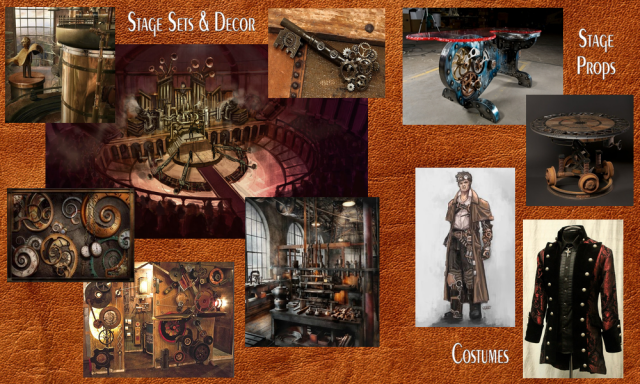
Sample Mood Board for Steam Punk Illusion Show
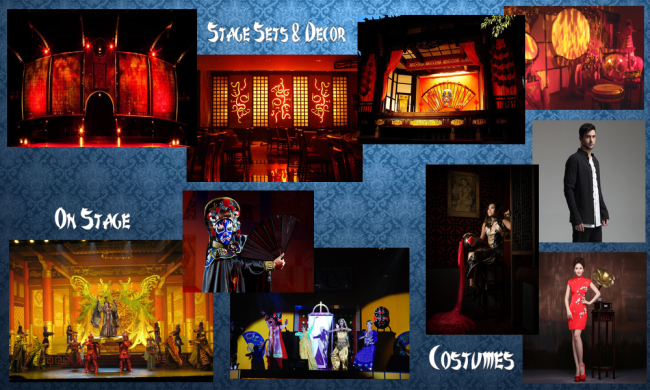
Sample Mood Board for Modern Asian Stage Magic Show
The great thing with a digital mood board is that you can include different forms of multiple media. So, if a sample of the type of music you will use in the show will help sell it, play it for the client to hear.
If you do intend to play music or video with audio, be sure to bring your own USB-powered portable speakers.
Show Highlights
This part of the presentation highlights key acts, routines or illusions in the show. At this point, the client does not need the entire show run-down but you should highlight 3 – 4 acts.
These acts should be the most impressive, memorable or exciting part of your show. It could be an award-winning act, a big illusion, prediction effect or something completely unusual.
I personally like the “gimmick” of selling a “world’s first, never been seen magic effect or illusion”. I have used it successfully in many of my projects including a large number of mega stunts.
However, if you do use this route, make sure that your “big trick” is really unique and you can deliver what you are selling.
Ideally, you want to have images or videos supporting a one-line description of the acts. However, if the acts are new or use props/ illusions that you have not bought/ built yet, it is unlikely that you will have any images or videos to showcase the act.
So, you need to be creative in putting together the presentation. Here are some options:
Existing Photos
Use existing photos that you have that might be of a smaller scale but conveys the essence of the act.
For example, if you are pitching a suspended upside down straight jacket escape but have not done it before, show a photo of you performing a regular, on the ground, straight jacket escape. Use text to highlight that in the new show, you will be performing the escape while suspended upside down.
Photoshop
Photoshop images of you performing an act as a visual representation of the act you are proposing.
If you are making an elephant disappear, photoshop an image of an elephant onto a picture of you presenting on stage. You will need to do some work finding the right photos to ensure the perspective is correct. A good photo editor will be able to blend the two images together if the perspectives are right.
Note: You are not trying to deceive the client and pass off the photo as the real thing. You are using this photoshopped image as a representation only.
Artistic Renderings
Hire a graphic designer to create artistic renderings and impressions based on images of the props/ illusion and draw you performing with the props/ illusion.

An example of an artist rendering of a corporate illusion
Illusion/ Prop Builder Photos
If you are performing a specific prop or illusion that is built by a professional builder, speak to him and explain that you are pitching a show to a client. See if the builder is open to provide you a picture of the prop that you can use for your presentation.
Other Performers’ Content
Look for public-posted content of props or performance photos of other magicians or illusionists to use as examples of magic effects or illusions that you will present in the new show.
I personally feel it is alright to use content (photos/ videos) from other performers’ shows as presentation examples and reference material, IF and only IF:
1) You are not deceiving the client into thinking that it is you in the content. You make it explicitly clear that the content is only representative of what you will be able to stage for the client
2) You only use the content for presentation purposes and you make it explicitly clear to the client that the presentation is for their internal review only.
Budget, Costing & Logistics
After exciting the client and hooking his/ her interest, you need to address an important concern to the client – how much your show will cost.
Depending on what stage of a pitch you are at, you might give a rough idea of the show budget or specifics. It depends if you are pitching for a one-off show or a run of shows.
You should also highlight specific technical requirements or logistics that you might need to stage the show. The client will want to know if they have to make any special provisions and this will be cost to them.
Step 4 – Perform a Strong Routine or Act
As magicians, we know how powerful a magic effect can have on a person.
Nothing caps off a business presentation better than performing a strong piece of magic.
Unless, you happen to be making the presentation on a theatre stage, you will likely be in a meeting room or office. More than likely, you will not be performing in an environment that is performance or magic friendly.
So, don’t try to do anything too theatrical or does not fit that environment. A manipulation act or a Sub Trunk will not be suitable in this environment.
Instead, do something that uses props that are fairly organic in such an environment. Ideally, borrow an object from the client or have him/ her involved in the magic that leaves a magical souvenir for him/ her.
It does not have to be a stage piece, it can be a close up piece. Just be sure it is strong and memorable. Most importantly, find a way to relate what you perform to an aspect or actual act in the proposed show.
For example, if you perform a strong piece of mind reading, explain that instead of reading one person’s mind, you will be reading the minds of 10 spectators.
If you perform a Ring Flight routine; explain that you will do the same thing in your show but the difference is that the ring will appear in a nest of boxes that is suspended in front of the audience from the start of the show.
Essentially, you want the client to imagine what his/ her audience will experience but at a larger scale.
Step 5 – Leave a Copy of the Presentation Behind
The final step to sell the show is to prepare a hard copy of your presentation and leave it with the client. This includes:
- A printed copy of the presentation in a word document format with images and photos. This hard copy may have more information and details that you elaborate on.
- A flash drive or USB stick with the presentation in PowerPoint format as well as folders for images and videos of available.
Leaving behind a copy of the presentation shows you have a complete and professional approach to selling your show. You are demonstrating that you are serious and this gives you some leverage when negotiating fees if the client decides to pursue the project.
A hard copy of the presentation also allows the client to discuss the project with colleagues, partners or bosses.
I have used this approach to selling big (and bigger shows) throughout my 20-year career with great success and I hope you can adopt some of the ideas for yourself. All the best!

